Showing posts with label bicycling. Show all posts

Thursday, July 3, 2014

Livin' La Pura Vida

Arenal Volcano
The North American and South American continents are connected by the Central American isthmus consisting of countries stretching from Guatemala on the northern end to Columbia in the south but it was not always so.  This relatively narrow strip of land is thought to be the result of volcanic activity as the western edge of the Caribbean tectonic plate pushes down on the Cocos plate beneath the Pacific Ocean.  Volcanic activity below the waves slowly built land masses that emerged along the fault as islands perhaps as recently as three million years ago.  The continuing eruptions added landmass that connected the islands into an isthmus.  Animal species that had not encountered one another now had a land bridge over which they could travel.  Add a varying topography and a range of climate conditions and you have a recipe for extraordinary biodiversity.  Costa Rica, located south of Nicaragua, north of Panama and just ten degrees of latitude north of the equator is ground zero for this incredible display of geological, biological and botanical diversity.  The lava show is not over yet.  Costa Rica consists of a mere .1 percent of the earth's surface yet it hosts more than 110 volcanoes, five of which are still described as active.

On his fourth and final voyage, Columbus sailed off of the Caribbean coast of the isthmus in 1502.  Encountering natives wearing some decorative items, he called the region Costa Rica or "Rich Coast" and evidently concluded that the area might yield more than a little gold.  Additional European exploration was quickly followed by exploitation which, along with disease, decimated native populations.  By the early 1800's, the region had become the Central American Federation and in 1838 the independent nation of Costa Rica was born.  Today it is one of the most stable and economically successful Latin American countries.

In a 1956 Mexican film called Pura Vida directed by Gilberto Martínez Solares, a comic actor named Antonio Espino uses the expression "pura vida" ("pure life") to express his unbounded optimism, despite his inability to do anything right.  The use of the phrase caught on in Costa Rica and by the 1970's it was used throughout the nation and has practically become the country's catchphrase.  It is used in a manner similar to that of "aloha" in Hawaii.

In March of last year we headed down there to experience pura vida for ourselves.  On this trip, I did something relatively new for me, I elected to drive for a part of our trip to a foreign land.  I was emboldened by the fact that I had purchased a computer chip for my handheld GPS (a Garmin e-Trex Vista CX) unit when we took our trip to Argentina and Chile last year.  The chip holds maps for most of South America and a quick check confirmed that it also held Costa Rica maps and that in addition to being compatible with the e-Trex, it was also compatible with the Garmin nuvi 2455LMT GPS that we use in our cars.  Additionally, the guidebooks I read indicated that driving in Costa Rica was no big deal.  The rate National quoted me wasn't too bad.

After landing in the capital of San José and clearing customs, we located the National counter and were promptly escorted a short distance to a waiting van for the quick ride to the office located off of airport property.  It took the counter attendant a moment or two to locate my reservation but once he did, all went smoothly.  We drove to highway 1 which is the Pan American Highway.  The original Pan American stretched from Laredo, Texas to Buenos Aires, Argentina, except for the break at the Darién Gap.  This was a busy urban highway with its share of quirks.  In places, large concrete-lined drainage ditches lined the side of the road so pulling over was not an option.  We went through one set of tollbooths where traffic officers were simply waiving everyone through.  I later learned from a cab driver that when traffic is heavy, tollbooths are opened up to speed traffic flow and when traffic subsides, the gates come back down and tolls are once again charged.  We exited the highway and ascended into the hills north of San José and through the town of Alajuela.

Thankfully, signs began appearing to guide us to our hotel because I had discovered one of the unique aspects of driving in Costa Rica: While a few streets do carry names, none of them actually feature signs telling you the name and address numbers are not used at all.  In making the reservation for our second hotel of the trip I had noticed that even on Marriott's website, the address of the Costa Rica Marriott Hotel San José is "700 metres west from the Bridgestone/Firestone".  No street.  No address.  Based on location estimates and on searches I could do on the GPS for specific hotels, I had saved a few locations into the memory of the GPS but other than that we were dependent on our own eyes and a few maps with the GPS offering some help.

To get out of the hustle and bustle of San José we had booked a room at Xandari Resort and Spa just north of the town of Alajuela which is itself just north of San José and a few hundred feet higher in elevation.  After some initial fiddling with the GPS, it lead us just about to the doors of the hotel itself.  Xandari consists of more than 20 small single story buildings scattered over 40 acres of hillside.  The hotel touts its eco-friendly practices.  We were greeted at the entrance by Andrea who quickly got us settled into room #3 which was in a secluded part of the grounds and featured a large patio with a westward view.  The buildings are of cast concrete which are painted in various hues of blue, green and coral.  Ours included a large window wall.  The upper course of windows consisted of glass louvers with screens to you could let in the breeze.  The rooms are not air conditioned but after a cold winter in the Chicago area we were ready for some tropical warmth.
The westernmost of the three pools at Xandari offered the best view...


... and at sunset the view was even more amazing

Our room at Xandari offered seclusion among the greenery

After getting settled we explored the orchard and plantings on the extensive grounds.  Pam had already returned to the room and I was just returning to the room myself.  As I knocked on the door since she had the key, I heard her exclaim, "That's the biggest spider I have ever seen!"  Having been married just over 20 years, I can say that I have heard her make that comment a few times but when I got in the room and looked at the foot of the small step down into the room I saw...   ... the biggest spider I have ever seen!  It was a tarantula and easily measured more than four inches in length.  I give Pam lots of credit for not making more of a ruckus and for being willing to walk within a few feet of this critter in order to let me into the room.  I think Pam thought I was heading for the phone to call the front desk but I promptly got my camera and recorded the moment for history.
This 4 inch-long tarantula was an uninvited guest in our room on the first night


We did call the front desk and a guy came with a couple of small banana leaves, picked up the spider and took it back outside.  Maybe it came in when the maid cleaned the room or maybe there was a crack somewhere it got through.  We searched the room pretty thoroughly and did not find any others but we knew we were not going to sleep too deeply that night.


The Owl butterfly is Costa Rica's largest with a wingspan that can reach 8 inches

Dinner in the hotel dining room was pretty good but the open air view of Alajuela and San José in the valley below was really great.


The view from Xandari's open-air dining room
The view during breakfast was equally beautiful
The main purpose for the trip was to take another Backroads biking journey but we wanted to experience more than one area of Costa Rica so we had arranged for a few nights at a hotel on the Pacific coast.  After breakfast at Xandari, we checked out and jumped in the car for our drive of about 100 miles to the hotel just outside of Quepos.  Of course, there was no "address" for the hotel but I had an approximate location and figured that signs or some friendly Costa Ricans would show us the way.  Driving in Costa Rica was as easy as I had imagined.  We took our time and enjoyed the journey of about three hours.  We passed through Quepos and, after a few wrong turns, did indeed find a sign for the hotel and arrived in fine shape.

Hotel Makanda By The Sea is a wonderful property and we knew we would enjoy our stay there from the moment we passed through the entrance gate.  The hotel is perched on steep hillside about 300 feet above the Pacific.  The weather was hot and humid but the sound of the Pacific waves pounding on the shore below and the shady jungle foliage let us know we were in another world.  We had reserved unit 11 and were quickly shown to our room which is on the edge of the property and feels wonderfully secluded.  A terrace stretching the full length of the room gave us a jaw-dropping view through the flower-draped jungle foliage to the sea.  The surrounding foliage echoed with strange bird calls and insect noises.  Hummingbirds flitted from flower-to-flower.

We explored the hotel property and soon came upon their pool and discovered a view that rivaled the one from our room.  The infinity-edge pool features a westward orientation and we knew the views of the sunset from there would be great.  Beside the pool is Makanda's small outdoor restaurant.  We spent the late afternoon by the pool and spotted toucans in the trees as well as a sloth.  The air was alive with strange sounds and just before sunset we heard the strangest sound yet.  The pool attendant said they were howler monkeys somewhere up in the canopy and they had plenty of company.  We spotted toucans and sloths.  The sunset was absolutely incredible and ranks right up there with the all-time great views!


The sunsets from Makanda's infinity-edge pool were incredible!
A howler monkey (photo by Andy P.)


What happened next almost ruined our trip.  I wanted a lower angle shot of the sunset and slid off of the edge of the pool, thinking that I would be in maybe four feet of water.  As I raised the camera to take a shot, I realized that I was going deeper and deeper.  Hoping that I was in perhaps six feet of water, I raised the camera over my head and was horrified to see it dip below the water as I found my feet touching the bottom of the pool in eight feet of water.  Clearly the camera was ruined.  I dabbed it dry and removed the battery and the chip on which the pictures were stored.  We needed a new camera pronto.  The desk clerk gave me the name of an electronics store in Quepos but they did not have cameras so we knew we had to get one on our return to San José.  In the meanwhile, we picked up a disposable film camera for use over the next two days.

We enjoyed dinner at the hotel restaurant that evening on the terrace next to the pool.  Before returning to our room, we ordered our breakfast for delivery to our room at 7:30 the next morning.  Breakfast is included in the room price.  Promptly at 7:30 breakfast arrived and we decided to enjoy it on our terrace.  Pam had an omelet but I had ordered the Costa Rican breakfast consisting of scrambled eggs, gallo pinto (white rice, black beans, onions, red peppers and cilantro) along with fresh fruit and fruit juice.  I was hooked.  The gallo pinto was delicious and each morning I got a different fresh juice (papaya, tamarind, starfruit).  As we enjoyed breakfast on the terrace, we heard rustling in the canopy and found ourselves amid a troop white headed Capuchin monkeys.  They were interested in finding their own breakfast in the jungle, not in mooching our meals.  We sat there in awe of this natural encounter and it dawned on me that perhaps the magic of Costa Rican wildlife is that to a North American it is the type of wildlife one sees in a zoo but in Costa Rica it is all around you and very close.  I was reminded of a movie quote:
"I own an island.  Off the coast of Costa Rica."  John Hammond (played by Richard Attenborough) in "Jurassic Park", Universal Pictures (1993)
One of the white-headed Capuchin monkeys that joined us for breakfast
We found this pair of crimson-crested woodpeckers on the hotel grounds


On our second day near Quepos, we arranged for a private tour of Manuel Antonio National Park.  Our guide George brought a spotting scope that brought wildlife in close.  We hiked for a few miles in the park and at one point found ourselves again accompanied by Capuchins as they foraged in the forest.  We spent part of that afternoon hiking down to the sea from Makanda.  The steep 300 foot descent to the beach brought on a sweat and we knew that the ascent would be even harder but were motivated by thoughts of spending more pool time.  The beach below Makanda is of dark gray sand.  Few guests venture down there due to the long, steep walk.  We got back to the hotel in plenty of time to watch another spectacular sunset from the pool.  On our final day at Makanda we took a boat tour along the Paquita River.


We found this python in the branches of a tree above the Paquita River

Before we knew it, it was time to get back to San José to begin the next phase of the trip.  It was tough to leave Makanda.  Some places you leave thinking that you may return.  I would be happy to return but its a big ol' world out there and I did not think it likely that we would return to this part of Costa Rica and I was sorry to think that I very well might have spent my last night at Hotel Makanda By The Sea.

Our return route to San José was on highway 27 which was evidently constructed recently since it was not on the GPS.  Still, we felt confident that the signs were directing us back to San José and pretty soon we were back in urban traffic.  I was following a public transportation bus on the Pan American Highway when it slowed down and pulled partway off of the highway.  I was shocked to realize that this was a bus stop (on the highway!).  Tollbooths that were open sporadically, bus stops on the highway, what's next?  Our Backroads trip was set to depart the following morning from the Marriott so we had booked a night there.  My advance work on estimating where the hotel might be and marking the location in the GPS paid off and we found it with no problem.  National had a rental car counter at the hotel so I dropped the car there.  Had I done more homework, I would have realized that we were probably less than a quarter mile from the main National office so I could have avoided the drop fee.  Live and learn.

The concierge at the Marriott confirmed that there was indeed a good electronics store in the Mega Plaza in San José.  He introduced me to taxi driver Pedro and we were off to replace the camera I had ruined.  As we pulled up to the mall, I told Pedro I would be back in a few minutes.  "Oh no, senior," he said, "I will go with you."  We looked over the camera selection and agreed on one that would fit the bill.  I reached for my wallet and Pedro gave me an imperceptible shake of the head and a warning glance.  He called the manager over and the negotiating began in rapid Spanish.  About midway through the conversation he turned to me and said, "You have cash, right?"  I did and the negotiations continued.  Before I knew it, I was walking out of there with a Panasonic point and shoot digital camera at a very low price.  The manager even threw in a free camera case.  Needless to say, the money I saved went for a handsome tip to Pedro.

As we arrive at a hotel the night before a Backroads trip begins, we play a game with ourselves and try to guess which guests we see in the hotel will be on our tour.  Often Backroads guests are easy to spot (biking or hiking attire).  At 8:30 the next morning we met Ally and Zach our guides for the trip as well as Scooby and Winnie, Costa Ricans who would be driving the support vans.  We met the other 12 trip participants and before we knew it we were in the vans and on the road.

Our drivers Winnie and Scooby made the trip easy

A one hour ride in the van took us north of San José to the Espiritu Santo Coffee Estate.  We receive an informative private tour of the estate and their coffee processing facilities and, of course, all the coffee we could drink.  A short shuttle ride later brought us to Candelaria, the starting point for our first ride of the trip.  Backroads guides work together to make the arrangements necessary for an efficient trip as seamless as possible.  Zach had left Espiritu early and had set up all of our bikes and the snack table.  When we arrived everything was ready.  I attached my GPS to the handlebars of the bike I was to use and stocked up on snacks and water.  As they do at the beginning of each trip, leaders then presented a short program describing the bikes and riding safety.  Each day riders are presented with detailed descriptions of the ride routes for the day, including turn-by-turn directions.  Riders can pedal for as long as they like and if they don't elect to do the full mileage for that day, they can quit at one of the pre-set break points or anywhere along the route.  Because this trip featured two van drivers, both Zach and Ally would be biking with us for the whole day.

Zach and Ally outlined our route before as every riding day began

Pam and I had elected to do the full route for the day and, according to the directions, that meant 21.5 miles (34.6 kilometers) and total climbing of 2,490 feet (760 meters).  The hills are definitely the most challenging aspect of these rides.  The directions feature detailed route information along with the distance (in kilometers) between points.  The most dreaded phrase on the directions as far as I am concerned is "Steep uphill begins".  Whenever I see that, my eyes dart to the left of the phrase to see just how long the hill is.  Riders quickly spread out as the route unwinds and it was customary to find ones self alone on a beautiful country road.  Understand that this is no Alpe d'Huez, the Alpine section of the Tour de France east of Grenoble where riders ascend 21 switchbacks in a little under nine miles, climbing 3,687 feet.  On this coming July 18 the riders in the centennial Tour will ascend this summit twice in one day.  Being a couple of flatlanders from Illinois, the most significant hill we face when riding around home is a highway overpass that ascends a total of perhaps 30 feet. 

After 15.5 kilometers, we stopped at Restaurant y Bar Mi Choza where we found the rest of the group gathering for lunch.  Small lunch spots like this in Costa Rica are known as "sodas".  The food is always good on Backroads trips and on this trip we found that the lunches were every bit as good as the dinners.  All meals were included in the price of this trip so when we were all done we stepped back out to our bikes and continued on our way.  Our afternoon route took us up into the Villa Blanca Cloud Forest.  By the time mid afternoon rolled around, we found ourselves enshrouded in the clouds for the last few miles.  We arrived at the Hotel Villa Blanca where Ally and Zach welcomed us.  It was as easy as taking the small pack that was strapped to the rear of our bikes off, turning the bikes over to Ally and Zach and heading to our private cabin on the hotel grounds.  We had time for a sauna before showering and heading to the lobby for cocktails before dinner.  On a trip like this, hours spent biking together as well as cocktail gatherings and meals give you plenty of time to meet others on the trip.  Dinner was delicious, particularly the roasted tomato and basil soup that started the meal.

On the morning of day two we met the local naturalist and he took us on a 2-mile walk through the cloud forest.  Afterward we had a shuttle ride to the starting point for our ride.  The previous day's ride had taken a lot out of us and we were not in shape to make the full 55+ mile ride that included ascending 4,704 feet and a ride along Costa Rica's continental divide.  We elected a shorter route that featured a net descent.  The route featured more traffic than we are accustomed to dealing with on a Backroads trip but it was some of the steep descents that really tested us.  A typical pattern was some flat riding followed by a steep ascent and then a descent into a valley where you crossed a river via a bridge and then ascended up the other side.  In the town of Bajos del Toro we had lunch at El Silencio and it was another winner.  There were a few raindrops as we started our afternoon ride but the sun soon reappeared.  Our hotel for the evening was Tilajari Hotel.  This Backroads trip was one of their "casual inns" trips that typically feature hotels that meet most expectations but are not five-star.  Tilajari was not fancy but the grounds were nice and the birdwatching along the river there was great.  That evening we gathered to celebrate the birthdays of two of our bikers and Ally and Zach prepared a selection of the fruits of Costa Rica before we all sat down to an outdoor dinner.

The next morning we gathered at the hotel restaurant for breakfast and noticed that the staff had placed slices of fruit on sugarcane stalks that were attracting some of the most colorful birds we've ever seen.  I'd noticed that the birds tended to nibble at the fruit slices higher up on the stalks.  I finished my meal and left but missed the most exciting event of the morning when one of the birds went for a piece of fruit on a lower branch and was seized by a small boa constrictor.

Wise birds go after the fruit placed higher on the stalk
Those birds who feed from the lower fruits often become breakfast for a boa


For our riding for the day, we elected to be shuttled to Santa Clara to begin our ride.  The hills of Costa Rica were definitely getting to us.  The riding on this day seemed to be the most scenic of the trip.  We passed countless fields and pastures on our way to the town of La Fortuna.  The landscape of this part of the country is dominated by the Arenal volcano.  Before July 29, 1968, Arenal had been dormant for at least 400 years.  The locals had even begun to refer to it as Cerro Arenal (Arenal Mountain).  On that fateful day, however, Arenal violently re awoke.  The ensuing eruptions killed 87 people and buried three villages.   We paused at one lonely road crossing to take a picture of the Arenal volcano in the distance.  A Costa Rican field worker was walking up the road in his straw hat with a machete tucked in his belt.  He gave us a hearty, "Pura vida!" and we responded in kind.  Our lunch spot for the day was the Lava Lounge and it was the best lunch yet: A slice of sweet Costa Rican pineapple, lightly grilled, placed atop a grilled chicken breast and smothered in a spicy sweet sauce.  In typical Backroads fashion, our hotel for the last two nights of the trip was the topper.  Nyara Hotel, Spa and Gardens in La Fortuna was a wonderful place to stay.  Our accommodations were private huts that featured outdoor showers and Jacuzzis, beautiful woodwork and two decks that put us right in the rain forest.

With views like this, it was hard to keep our eyes on the road
A typical rural road


While the hilly volcanic landscape provided plenty of biking challenges, the geothermal activity of the area brings one benefit to those with sore biking muscles (and backsides): Natural bubbling hot springs.  Eco Terminales hot springs.  We enjoyed a dip in the hot springs and a refreshing drink, followed by dinner.

Day four began with a quick shuttle to the Lake Arenal Dam and a boat ride across the lake.  Our drivers Winnie and Scooby were to meet us at the dock after our ride when we would begin our ride around the lake.  Low water conditions made the use of our planned arrival site impossible so the boat driver told us he would drop us at another spot on the shore.  We wondered how far we would have to walk to get to the road but there was no need for concern.  As our boat neared the shore, along came the vans with Winnie and Scooby happily doing some off-road navigating.  As we drove to the spot where we would begin biking, we spotted toucans and howler monkeys in the trees and a family of coatimundi.  The lakeside road supplied lots of scenery and a couple of challenging hills.  As I rounded a corner and finished the ascent of one hill, I was relieved to find the van parked by the side of the road.  Winnie was refilling water bottles and pointing out a sloth he had located in one of the trees.  I was out of breath after climbing the hill as I rode up to him.  He asked me in Spanish whether I wanted water.  I said that I had plenty, thanks.  Did I want fruit?  No, thanks, I said.  A smile crept onto his face: "¿Tanque de oxígeno?"  He knew just how to poke fun at an out-of-shape gringo.

A troop of coatimundi (photo by Andy P.)

After a boat crossing of Lake Arenal, we climbed on our bikes for a ride and enjoyed great views

Many of our fellow travelers elected to go ziplining that afternoon while a few of us elected to go on a hike through the jungle on a trail that featured hanging bridges through the canopy.  We met for cocktails at Nyara's wine bar that evening and then walked to the hotel's restaurant for dinner.  After four days of biking together, we felt like a group of old friends.

The hanging bridges  made it easy to walk right up in the rain forest canopy


On the final day of the trip our 21.4 mile biking route took us along the scenic roads surrounding the volcano.  We stopped at a roadside stand for a refreshing drink from a coconut.  Lunch was at Proyecto Asis, an ecological reserve and animal rescue center.  We were then driven back to the Marriott in San José where we said our good byes.  As with every Backroads trip we've taken, the guides were great and our fellow guests made the whole trip a pleasure.  We headed back to Xandari for one more night's stay before returning home the next day.

Roadside stands provide great fruit snacks


Costa Rica is an ecological gem.  We saw a lot of this beautiful country but there is much more to see and I hope we can return.

Monday, September 10, 2012

2012 Ore To Shore Mountain Bike Epic


I imagine if you are the chief orthopedist at Marquette (Michigan) General Hospital that it might not be easy to get the second Saturday of August off.  As a matter of fact, if I were that person, I would report to work, scrub up and calmly wait at the emergency room entrance because some business will definitely be coming your way.  This past August 11th was the 13th annual Ore To Shore Mountain Bike Epic, billed as Michigan's largest point to point mass start race.  Those choosing to participate had a number of events from which they could select:
  • Hard Rock (48 miles)
  • Soft Rock (28 miles)
  • Shore Rock (10 miles)
  • Junior Rock (4 miles)
  • Little Rock (1 mile)
  • Littlest Rock (50 yards)
Last year my brother Rob, sister Anne and Pam and I all did the Soft Rock.  This year Rob and I elected to do the same event again.  Our family summer home is just west of Marquette so we don't have a problem getting to the race.

This is primarily a trail race that is run on the two-track logging roads and trails between Negaunee and Marquette.  Let me make this clear, I am not a racer, nor am I a mountain bike trail rider.  Most of the 1,300+ miles I have biked so far this year could be described as path riding.  My Trek 7200 is not suited for this type of trail riding so my brother John kindly lent me his Giant Rincon for the ride.

My brother John loaned me his Giant Rincon for the ride
The evening before the ride we reported to Lakeview Arena in Marquette to pick up our race materials.  A local service club puts on a $7 spaghetti feed for riders as a fundraiser.  Rob and I waited a short time in line and received our packets and then enjoyed the dinner before returning to our cabin for the evening.

Participants line up to receive race materials
My Bib

The weather was cool but clear as participants assembled near the shore of Teal Lake in Negaunee for the start of the race.  Organizers advised us that the temperature was already 12 degrees warmer down in Marquette and we expected sparkling conditions for the ride.  The number of riders signed up for the Soft Rock was a record 1,160.  There were signs suggesting where riders should line up based upon their projected finishing time.  Elite qualifying riders were lined up at the head of the pack since they were expected to be in the hunt for a prize money winning race time.  I wasn't in the race to try to score under a particular time so I stayed well away from those gunning for a cash prize.

Participants line up the morning of the event
Rob is ready to go!
Signs indicated where participants should line up based on their expected race times

Here is the sign I lined up behind!
The starting gun went off at 9:00 and the crowd started moving.  The first couple of miles was on a roadway and we were under police escort.  The escort then ended and we turned off into the woods.  At this point the racers are all still bunched together and conditions are ripe for a bike-to-bike crash.  After 15 minutes or so the crowd disperses over the course and there were plenty of times I found myself alone.  Rob moved ahead aggressively since he was looking to come in under 3 hours, bettering his time from last year.  There were a few tandem bikes as well as a few folks who rode single speed bikes.

On the trail
There were some limited views of Lake Superior but riders were wise to keep their eyes on the trail ahead
Much of the course looked like this

The iron ore still mined in this part of Michigan's upper peninsula makes the predominantly downhill ride to the Port of Marquette on Lake Superior, thus the name Ore To Shore.  Click here to see a map of the course.  Simply because there is a gross loss of altitude as one rides the 28-mile race, don't be fooled into thinking that it is all downhill.  There is plenty of uphill and more than a few of the downhills consist of large rocks scattered among soft sand.  Our Midwest summer has been pretty warm and dry and while the Upper Peninsula was not under drought conditions, the trail was dry and featured much more loose, soft sand than last year.  Conditions were challenging and I worked to stay back on the bike during descents and to maintain control of steering as I negotiated the dry, sandy areas.  I did not see any crashes this year but saw many more flats and bike chain problems than last year.  I did see a couple of folks walking off the course with shoulders that were clearly giving them pain.


"Caution, Fast Decent"?  Oh, no, "Clavicle Hill" is the most notable descent on the course.  Just over the horizon in this photo it drops very steeply.
I had no trouble at all until about mile 24.  I was rounding a very sharp curve in the course amid tree roots.  I turned sharply to the right to make the turn and went over a tree root but my wheel came up parallel to another root and turned even more sharply right.  I was too far forward on the bike and the bike fell over with me on the top of it.  Other than a coating of dirt from my chin to my waist, no harm was done.  I pushed on.

As I rounded the last turn into the parking lot of Lakeview arena and the finish line, the crowd let out a great cheer.  For a second I basked in their roar of approval for my accomplishment until I noticed that, rather than looking at me, they seemed to be looking over my shoulder.  I glanced back and saw the leading riders of the Hard Rock bearing down on me like the Four Horsemen Of The Apocalypse.  The order of finish: Cole House (age 24) of Oneida, Wisconsin, Brian Matter (34) of Sheboygan, Wisconsin, Mike Phillips (35) of Chicago, Illinois and Christian Tanguy (37) of Rochester, Minnesota all finished with a second separating first and fourth place and all averaged a whopping 19.7 miles per hour over their 48-mile course.  That's right: They all started later than I did, rode 20 miles more than I did and they still beat me to the finish.

The first place finishers of the Hard Rock of each gender win a cash prize of $1,600 with additional prizes awarded to other top finishers.  The first place finishers of the Soft Rock of each gender get $250.  Rob met me at the finish having bettered his time from last year and reached his goal.  I wanted to better my time from last year and did so but it was not a race as far as I was concerned.

The Ore To Shore is a great event and for those accustomed to trail riding, I recommend it.

Sunday, July 1, 2012

Better L.A.T.E. Than Never


At 1:00 a.m. on Sunday, July 1st the 24th annual L.A.T.E. Ride kidked off on time.  The name stands for "long after twilight ends".   I decided to be a part of this madness this year.  The ride supports the Friends of the Parks organization that benefits greenspaces in Chicago.

I registered for the ride months ago and let friends who bicycle know of my plans but for some reason, none of them decided to join me!  A week ago I picked up my ride materials at an R.E.I. store near my home.  At about 11:30 Saturday night I put my bike on the rack we have for it that mounts on the back of our car and I headed downtown.  Pam and I rode "Bike The Drive" in 2010 and 2011 which is held on the Sunday of the Memorial Day weekend.  As you drive downtown for that one early in the morning you see bikes on just about every other car headed into the city on the Eisenhower.  Not so this past Saturday night.  I wondered whether I had the right night but as I reached downtown, dozens of cyclists could be seen moving from parking garages toward Columbus Drive.
As I approached Columbus Drive I could see thousands of cyclists lining up
Cyclists were each registered into one of six randomly assigned color groups.  I was assigned to the green group, the third wave of participants slated to be released onto the course.  I took my place among the hundreds lined up behind the sign designating the area for green cyclists.  Music blared from speakers in the assembly area and everyone was in a festive mood.  About ten percent of the participants were in some sort of costume or wore decorative lights of some type.

Bibb color determined your starting group


A few riders wore costumes or colorful light displays


Looking south on Columbus Drive at the crowd lined up ahead of me


I'm ready to go...


... and so are more than 8,000 other riders
Promptly at 1:00 a.m. the riders in the first wave started south, followed a few minutes later by the second wave and then it was my turn.  Like most events involving a large number of participants, it took a couple of minutes for everyone in the group to be on the move and biking was slow for the first couple of miles but people were enjoying the party atmosphere.  As we moved south on Columbus and then turned right on Roosevelt, police had the intersections blocked off from traffic and were waving cyclists on.  We continued south on State and then right onto Archer Avenue where went through Chinatown and then turned right onto Cermak.  At Halsted we turned north and cycled through University Village and then through Greek Town.  We turned northwest onto Milwaukee and then west onto Division Street.  By this time we no longer had intersections blocked off for us and we had been told to obey all traffic signals.  We stopped at most stoplights but most participants went through intersections where there was no traffic.

Traffic signals were not the only rules that were ignored.  The vast majority of riders had helmets but some didn't bother with them.  I did not see any accidents but I did pass one guy who had taken a spill and was being attended to by friends.  It did not look serious.  For an event like this, you always get a few participants who did not bother to officially register. I counted plenty of folks who did not appear to be wearing a bibb indicating that they had registered.

By the time we turned north onto Humboldt Boulevard, biking traffic had thinned out a bit and I had moved up a little in the pack.  After moving through Humboldt Park, we turned east on Logan for a short distance an then left onto California for the trip all the way to the halfway point of the ride at Horner Park.  I stopped and had some water but did not need any of the other serivces offered so I got back on the course, turning right onto Montrose and headed toward Lake Michigan.  There were eight or nine service areas along the course where volunteers were fixing flats or attending to other mechanical problems.  Additional volunteers along the route who guided biking traffic or rode with us were able to communicate with ride leaders if anyone needed help.

It was stressed more than once that this was a ride, not a race and most people were careful.  By the time we got to Lake Michigan, it was time to take a right on the Lakeshore Path for the long ride south.  It was great to not have to worry about car traffic any longer.  Bike traffic had thinned out a lot since some riders were slower or had stopped along the way.  I enjoyed a great ride along the lakefront under the light of a mostly-full moon and clear skies.  We continued all the way south to Museum Campus and then turned north for the short ride back up to Buckingham Fountain.  I finished the 25 mile course at a little before 4:00 in the morning.  Some had opted for the $7 pancake breakfast and were waiting to witness sunrise over the lake.  I packed up my bike and headed home to bed after this great ride and unique look at a few of Chicago's neighborhoods.

Sunday, May 6, 2012

Wine Roads Of The Andes


In late March 2012 we hopped a flight to South America for a bicycle trip that included parts of Argentina and Chile.  We had made plans to spend a few days in Buenos Aires on our own and then join the trip offered by R.E.I.  We would be going from early Spring in the northern hemisphere to early Autumn in South America.  We looked forward to seeing two of the continent's major cities, Buenos Aires and Santiago, and to miles of riding in the vineyards and countryside, all in the foothills of the incredible Andes mountains.

Buenos Aires
We elected to fly into Buenos Aires, Argentina a couple of days before our tour was due to start and to stay at the Esplendor Buenos Aires hotel, the same hotel in which we were due to stay for the first couple of nights of the tour.  The Esplendor is in the Microcentro section of downtown Buenos Aires.  It is a 5-story building situated at the intersection of two busy streets (San Martin and Avenue Cordoba).  The hotel goes for a sort of modern vibe but doesn't quite pull it off.  The place was a little worn and torn but the location could not be beat.

We opted to be picked up at the airport by a car arranged by the hotel for the 40 minute ride from the airport to the hotel.  I was happy I had picked up a few Argentinian pesos before departing the U.S. for minor expenses like tipping the driver.  While I never tried to pay any bill with U.S. dollars while we were in South America, I had the impression that most places would not have accepted them.  We arrived early in the morning after our eight hour flight from Miami.  Argentina charges a $140 "reciprocity" fee to enter the country.  The fee is good for ten years and is collected at customs via a charge to your credit or debit card or in U.S. dollars or Argentinian pesos.  Travel hint: When paying in U.S. dollars, bring clean, newer currency.  Each bill we presented was carefully looked at and a couple of 20's were returned to us due to tears or stray marks on the bills.  We stowed our luggage at the hotel and struck out on our first walk through the city.

Argentina in general and Buenos Aires in particular have been more heavily influenced by Europe over the past few centuries than have other South American countries.  The city is the nation's capital and its largest city and primary port.  It is situated on the western bank of the Rio de la Plata river, 150 miles (240 kilometers) from the Atlantic.  European influence, especially French, is apparent in their culture, the faces you see on the street and the architecture.  The city has been called the "Paris of South America" and it does seem that way but this ain't Paris.  The city contains many wide boulevards, including the widest in the world, Avenida 9 de Julio which is 16 lanes wide and is actually made up of a couple of parallel streets.  There are any number of narrower streets with similarly narrow sidewalks in various states of repair.  Porteños ("people of the port"), as the nearly 10 million people of the greater metropolitan area are known, love their dogs as much as do Parisians.  I just wish they cleaned up after them as well.  Graffiti was also featured on a number of buildings.

Still, there were many bright spots.  Few people define Argentina as does Eva ("Evita") Duarte de Perón, especially as she is portrayed in the musical "Evita" (music by Andrew Lloyd Webber, lyrics by Tim Rice).  The Cementerio de la Recoleta is a very popular tourist site and they all flock to the Duarte family vault in the cemetery to see her final resting place.  The cemetery is stuffed to overflowing with the remains of everyone who was anyone in Argentina from presidents to Nobel laureates.  Some of the vaults are lovingly tended while others are in very sad disarray.  The Basilica de Nuestra Señora del Pilar next to the cemetery dates from 1732 and is as beautiful as the cemetery is somber.  There is a lovely park in front of the basilica (below).


In addition to the world's largest collection of Argentine art, the Museo Nacional de Bellas Artes contains a knockout collection of Flemish, Dutch, French, Italian and European paintings and other art objects.  This museum should be near the top of the list of any art lover visiting South America.  Additionally, the wonderful gardens in the city are worth a visit.

Jardin Japonés (Japanese Garden) is a wonderful walled garden oasis.
Within the Parque Tres de Febrero is the Paseo del Rosedal or rose garden which features more than 12,000 rose plants representing more than 1,000 species

Argentinians eat dinner late.  We found it easier to get into this practice than we expected.  One memorable meal was at Dadá (San Martin 941 in Microcentro, Buenos Aires).  To avoid the crowds we arrived at a few minutes past 7:00 one evening.  The place looks like a pub but the food was supposed to be great.  And it was!  Pam selected the Lomo Dadá, a fillet of Argentinian beef atop a stack of sliced potatoes a la Rosemary.  I had the chicken fricassee and we washed it all down with a bottle of Malbec from Ruca Malen that the waitress suggested.  Why did Ruca Malen sound familiar?  We tried our Spanish but the waitress spoke flawless English.  We asked her if she had spent time in the U.S. and were very surprised to learn she had not.  She got started learning her English, she said, by translating Jon Bon Jovi lyrics!  We paid for our dinner with a credit card which was cheerfully accepted but tips during our trip had to be paid in cash and could not be added to credit card transactions (another good reason to bring a few pesos on the trip).  By 8:30 Dadá was hopping and there wasn't a table to be had.  Go here but go early.

The Tour Begins
After two and a half days on our own, we met our fellow travelers as the tour began in our hotel lobby the evening of March 24th which I will call tour day 1.  There were 12 of us comprised of five couples plus two single women.  Ages ran from early 40's to early 70's and it was immediately apparent that we were going to be a jolly group.  Our guide was Victor, a porteño and married father of three who had been leading tours in Argentina and Chile and the wine regions of these countries for several years.  We hopped into a comfortable van and we were off to dinner.

La Cava de El Querandi is a wine bar and restaurant in San Telmo, the first suburb of Buenos Aires.  The area has become trendy recently and we had a good meal, sampled a few Argentinian wines and got to know one another as Victor started to describe the trip.  Our van had to skirt around a raucous protest as we headed back to our hotel.  The demonstration was not violent and actually seemed more like a party.  For several years now, March 24th has been a national day of remembrance to commemorate the 1976 military coup.  Much of it centers around the Mothers of the Disappeared who still gather to demand justice for the thousands kidnapped and killed by the authorities.

On tour day 2 we gathered at 9:00 a.m. and strolled a short distance through Buenos Aires to one of the parks.  It was Sunday so the downtown area was much quieter than during the workweek.  We met our city guide and jumped on single-speed cruiser type bikes for a ride through the neighborhoods of the city.  We visited a number of the spots we had found on our own before the tour but saw many other parts of the city as well.  After lunch at a local spot, we biked through the Recoleta and Palermo neighborhoods, ending up at the country's memorial to the 1982 war with Britain over the Malvinas Islands which pretty much everyone outside the country calls the Falkland Islands.  That evening we visited a local tango spot.  Argentina identifies heavily with this dance that is said to have been born in the poorer sections of town as a forbidden activity due to its suggestiveness.  Many of us on the tour found the venue to be a little too down at the heels and crowded.  Perhaps a performance of the dance might have been better.

We were blissfully unaware that as we prepared to go to dinner on this evening, a 7.1 magnitude earthquake struck in the Maule area of Chile, about 175 miles southwest of Santiago.  The trembler set buildings swaying in Santiago and there was some panic but no substantial damage.  On February 27, 2010 a quake measuring a whopping 8.8 struck off the Chilean coast north of Concepcion, a little further south than the one that struck during our visit to South America.  This was the sixth largest earthquake ever measured by a seismograph anywhere and cost more than 525 people their lives.

Flying to Mendoza & Cycling the Central and Uco Valleys
We got up early on day 3 since we had a flight to catch.  We departed from the city airport in Buenos Aires and flew almost two hours to Mendoza, Argentina in the heart of the wine country and in the foothills of the Andes.  We met our van driver Fernando and proceeded to Archaval Ferrer winery.  Since Autumn was just beginning, many of the grapes were in the process of being picked and crushed.  We had a thorough tour of the winery and then sat down in their tasting room for a "vertical" tasting of their Malbec wines made from grapes grown at different altitudes in different Terroirs.

The Malbec grape remains a minor blending grape in the Bordeaux region of France but the Argentines have taken it as their own.  They produce pure varietal Malbecs and blend it with Cabernet Sauvignon and other grapes.  Control is the name of the game as vintners carefully trim their vines and limit the number of grape bunches to concentrate the flavors of the somewhat small, dark, juicy grapes.  Planting vines on this side of the Andes means that they will not have the benefit of cooling ocean breezes but that vintners can carefully control the amount of water the vines receive through irrigation and letting the intense sunshine thicken the flavorful and colorful skins of the grapes and further concentrate the essence of the fruit.  The vines are carefully trimmed to permit the sun to do its work.  We saw plenty of vineyards where the vines grow thickly until they intertwine and actually form a "roof" that substantially shades the grapes.  These are table grapes and they are very different than the grapes used for wine.


As with any agricultural enterprise, nothing is risk free.  They can largely control the vine's exposure to water through irrigation thanks to the water from the Andes and a fairly dry climate but a rare late season rain could produce watery grapes.  Mostly, though, they live in fear of hailstorms that can damage or even destroy a crop.

We had a late lunch in Tupungato in the Uco Valley and then planned to set out on our first ride in wine country.  R.E.I. provides Zenith mountain bikes and I must say ours were not in top-notch shape.  Combine that with a late start to the ride after lunch followed by a stop to change into biking gear in a gas station bathroom and a few of our fellow travelers were a bit cranky.  We biked 27 miles through the valley past vineyards, orchards and farm fields.  Our guide while on the bikes was a fellow named Santiago, a cheerful guy who, with his limited English, tried to keep track of a dozen independent minded Yankees.  Some thought he biked too slow, others said he biked too fast but the miles flew by.  Autumn had turned some of the thorns on the roadside plants from soft and green to dry and hard and we did have a few flat tires.  Victor and Fernando were following in the vans and any flats were fixed quickly.  Still, the bikes were not up to snuff and something had to be done.

We spent the next two nights at the Uco Valley's Postales del Plata Lodge, a small hotel at the edge of a vineyard.  The chef fixed us a very nice dinner and we collapsed into bed after a long day.

Sunrise over the vineyard at Postales del Plata

Renowned French winemaker Michel Rolland is part of a consortium of investors who created Clos de los Siete.  It is the site of seven different wineries and we cycled there from Postales on day 4.  The day began with the delivery of bikes to our hotel to replace the ones on which we had started the journey.  These bikes were in better condition and resolved many of the concerns we had been expressing about the condition of the equipment.  DiamAndes is the Argentinian operation of a French wine making family.  They have about 320 acres of plantable land in the Clos de los Siete project.  Travel hint: Unlike vineyards and wineries in other parts of the world, the wineries and vineyards in Argentina and Chile require that visitors make reservations in advance.  Your hotel concierge can arrange this.

Clos de los Siete
DiamAndes winery
Some of DiamAndes vats

Aged in French oak barrels which are disposed of after 3 uses

In the tasting room, we gave their 2008 Gran Reserva
(75% Malbec, 25% Cabernet Sauvignon) high marks

 We started day 5 with a 15 mile ride through the Central Valleys along the back roads.  We saw orchards and even picked some walnuts from roadside trees to sample.

We were getting closer to the Andes
So far, we'd had very good food on this trip but our guide Victor advised us that the best meal was yet to come. We had a lunch reservation at Ruca Malen (translates as "young girl's house"). That's why the wine we'd had at dinner in Buenos Aires sounded so familiar. I'd seen Ruca Malen on our itinerary before we departed and hadn't made the connection. Once we finished our 5-course tasting menu lunch, virtually all of us agreed that it was the best meal of the trip and one of the best meals many of us could remember eating. Each of the first four courses of the meal were paired with a wine in this beautiful restaurant located right in the vineyard:
  • Cold summer vegetable soup perfumed with asahar flower (from the orange tree) and torrontés grapes paired with their Yauquén Torrontés 2011, a white wine that is not aged in oak.
  • Pork sausage (chorizo) served on a slice of grape skins bread, criolla sauce and Argentinean cereal paired with Yauquen Malbec-Cabernet Sauvignon 2010 which was half Malec and half Cab that are combined, then 30% is aged in oak for six months before the wine is brought back together.  The food was served on a plank of oak that was taken from one of the aging barrels.

  • Beetroot cooked on honey and cinnamon, with seared goat cheese on a spicy arugula infusion paired with Ruca Malen Syrah 2008 which had spent 12 months in oak (80% French, 20% American).
  • Grilled beef tenderloin medallion with potatoes that had been boiled, fried and then baked, baked onions, olives, raisins and Arauco olive oil perfumed with lavender from the winery garden was paired with Ruca Malen Malbec 2010 that had spent 12 months in oak (85% French, 15% American) and Kinien Malbec 2008 aged 18 months in oak (90% French, 10% American) then aged 18 months in the bottle.
  • Seared fruits on a lemon infusion with dry fruits and vanilla ice cream.
No one would describe me as a gourmand but this was a very fine meal.  "Who cooked this?" we wanted to know.  Chef Lucas Bustos appeared and was kind enough to answer our questions for a few minutes.  He's working on a cook book and I have a feeling that he pre-sold at least seven of them with that meal he cooked us.
Chef Lucas Bustos cooked us a great meal
Viticulture was brought to this part of the world with the Spanish in the 16th century.  Nicola Catena planted Malbec grapes in Argentina in 1902 when he emigrated from Italy but it was his grandson Nicolás who became convinced that Argentine wineries could produce wines equal to the best in the world and essentially launched the fine wine revolution in Argentina, if not South America as a whole.
After lunch at Ruca Malen, we traveled to Catena Zapata.  This three-floor winery is in a building reminiscent of a native pyramid.

In front of Catena Zapata

The view from atop the winery was amazing

Some of the more than 3,000 barrels (all French oak) in their barrel room

We tasted their 2009 Alta chardonnay, 2008 Cabernet Sauvignon and 2008 Malbec

Our group in front of Catena Zapata

The Mighty Andes
We continued to ascend the eastern slope of the Andes on day 6 with a drive to Uspallata.  The village resembled the central-Asian highlands enough that director Jean-Jacques Annaud used it as the base in his movie "Seven Years in Tibet" adapted from Heinrich Harrer's memoir and starring Brad Pitt.  We began our biking for the day outside town and after proceeding through town we rode a lonely trek in Uspallata valley toward some pre-Colombian petroglyphs.

Our biking on day 6 started south of Uspallata at just under 6,000 feet

We moved higher outside of Uspallata...

... and biked toward some pre-Colombian petroglyphs

After our 15 mile ride, it was time to continue our driving ascent toward the Chilean border and for what I hoped would be a highlight of the trip: Aconcagua.

Ask people to name the highest peak in North or South America and many will name Alaska's Mt. McKinley (6,194 meters, 20,322 feet).  While McKinley, located in the Alaska, range is indeed the highest peak in North America, Aconcagua (6,959 meters, 22,814 feet) is the highest mountain on either continent.  Oh, you might say, McKinley might be the second highest.  I was surprised to learn it is not even close.  There are 18 additional peaks in the Andes that are higher than McKinley.  This is one stupendous mountain range.

We walked half a mile or so up to a viewing platform for Aconcagua, the peak in the far distance

The south face of Aconcagua.
The peak lies about 15 miles away and almost 13,000 feet higher from this vantage point.

Argentina and Chile share a border that is approximately 3,200 miles long, the third longest border between any two countries in the world.  Except for far southern Patagonia, most of the crossings between these two countries are in the Andes.  There are only a dozen or so major crossings.  We crossed at Paso Internacional Los Libertadores at about 3,500 meters (11,483 feet) above sea level.  The crossing includes a 3,175 meter (10,417 foot) long tunnel at its highest point.  As of this writing, an April 17, 2012 magnitude 6.7 earthquake has partially obstructed Los Libertadores.

Portillo Hotel is about 1 kilometer after the border crossing.  Although the lodge is closed until the ski season starts, we spent the night there in some of their "chalets" on the hotel grounds.  Believe me, "chalet" is not an appropriate descriptor of these accommodations.  The trip materials described them as "rustic" and they struggled to get up to that level, in our opinion.  More than one ski speed record has been set at Portillo and to my eye, the skiing did indeed look like it would be challenging.  We may have been situated at almost 10,000 feet above sea level but we were surrounded by higher peaks.  As we walked back to our "chalet" after dinner that evening, I pointed out the light of the moon peeking from behind a high cloud bank.   After a moment, I realized that the cloud bank was actually a mountainside.  Despite being at 10,000 feet or so, we were surrounded by higher peaks.  The hotel is situated on the shore of a beautiful small lake.


On the morning of day 7 we departed the lodge and headed for Chile's capital city of Santiago.

Chile
On the Argentinian side, the Andes rise step by step over many miles but on the Chilean side they plunge toward sea level quickly.  There are no less than 32 tortuous switchbacks as you descend from the border toward Santiago and they are tightly packed.

Descending into Chile and not a guardrail in sight

We enjoyed lunch at a restaurant near Santiago's Mercado Central and then went on a walking tour of the city that started with the market itself.  The major metropolitan area of Santiago has about half the number of people in the Buenos Aires region.  We found the city to be brighter and cleaner than Buenos Aires, with the exception of the air quality.  The Hotel Leonardo da Vinci where we stayed would be a good choice for someone visiting the area.

Chile is a major seafood producer and it is all for sale at Mercado Central 

Our guide Cecilia describes the wide variety of fruits available in the market 

La Moneda is the presidential palace in Santiago

Chilean Wine Country
The Colchagua Valley south of Santiago is home to some of the country's best wineries and that's where we drove on day 8 of the tour.  After walking around the small town of Santa Cruz and having lunch at a local spot, we spent the afternoon cycling the countryside and admiring the local vineyards.  As we pedaled down one of the roads, we noticed that the right hand margin of the roadway was kind of sticky with tar.  As we approached one of the co-ops that takes in grapes, the sticky path that we thought was tar led right into the co-op.  It wasn't tar we were encountering, it was grape juice that had dripped off of the trucks taking the harvest to be processed!

Our biking for the day ended when we entered the driveway of the Vina Sutil Winery, home to the Hotel Vina la Playa, our hotel for the next couple of nights.  Most trips like this try to end on a high note by housing you in the nicest hotel of the trip and this was no exception.  It is a beautiful property.
Biking the back roads of Chile's Colchagua Valley

  Vina Sutil driveway entrance - only a mile or so to go to get to the hotel

Hotel Vina la Playa grounds

We gathered that evening for our own wine tasting

On day 9 of our trip we set out on our bicycles for the village pf Peralillo.  The village was quite busy since they were preparing for the Vendimia Paralillo, their annual celebration of the grape harvest.  We cycled through the festival grounds and decided that we would visit later in the day after we had completed our biking.  In no time at all we'd left the village behind and were out on the country roads.  It was another perfect weather day.  On the day we toured Buenos Aires a week earlier we'd had some clouds but since then, the weather had been clear and perfect and today was another sparkler.

Hotel Vina la Playa

Ready to ride

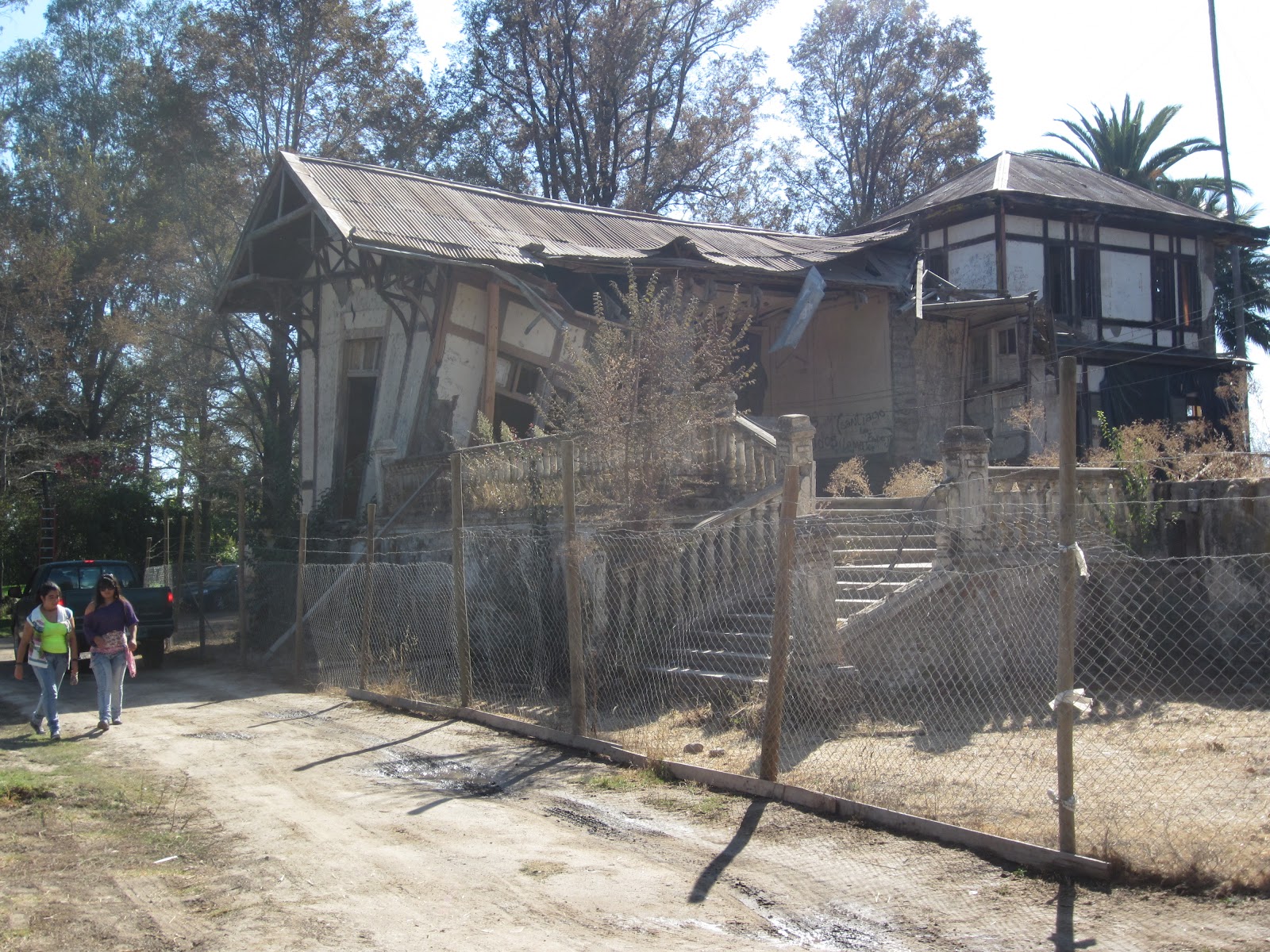
 2010 earthquake damage near Paralillo

Our ultimate biking destination on day 9 was MontGras Winery. The Colchagua Valley provided vista after vista as we went through small towns and passed vehicles bearing the grapes that were being harvested up and down the valley.  Unlike Argentina, Chile exports far more wine that it consumes.  The Chileans seem to concentrate more on white wines which grow well in their cool coastal environment.  While Argentina has embraced the Malbec grape, Chile has rediscovered the Carmenère, a red Bordeaux blending grape that came to Chile from France in the mid-19th century.  Both countries of course love Cabernet Sauvignon.
After walking among the vines and tasting the various grapes (the Sauvignon Blanc grape really tasted like the wine), we went to the blending room and divided up into 3 teams.  We tasted wines made from their Carmenère, Cabernet Sauvignon and Merlot grapes and then each team made its own custom blend.  Our winery guide and Victor our tour guide were the judges in a blind taste test.  While the winery guide liked ours best, Victor chose another team's wine and they both judged the third wine to be second best.  It was a tie so Santiago our biking guide was called in to break the tie and our wine was not chosen.  All teams then got the opportunity to bottle, cork, label and seal their custom blend.  Afterward, we enjoyed an outdoor lunch in one of the winery's courtyards.
MontGras Winery vineyards


At MontGras we spent a lot of time walking among the vines tasting the grape varieties


Sampling Sauvignon Blanc that had been in the vat just 3 weeks

Our team's custom blend of Cabernet Sauvignon, Merlot and Carmenère impressed
 the winery's guide but ultimately was not judged the best

Many of MontGras' wines spend time in barrels made of American oak.

 
The blind taste test proved our team has no future in blending wine

Time for lunch
After lunch we drove back to the festival in Paralillo where we shopped the stalls, sampled more wines of the area, visited the rodeo and generally enjoyed this really nice small town celebration.  We appeared to be the only tourists at the event.  That evening we enjoyed a final dinner together at the hotel.  We sampled our custom blended wines but agreed that the professionals did a better job.  Many bottles were opened and things got just a little raucous.


Paralillo's harvest festival included a rodeo, bands, wine samples from local wineries and lots of barbecue

There was a little fog over the vineyards for those of us who managed to rise early on the last day of our tour.  Two of the guys and I were the only ones who elected to take the final optional ride.  We enjoyed one last look at the local scenery.  In the vineyards on the grounds of our hotel, it was time to harvest one of the grape varieties.  We watched the pickers arrive as we cycled out for our ride.  After we returned, we watched them as they each picked two containers of grapes, then trotted down the row to the tractor where the grapes were loaded into containers for the ride to the winery.  The pickers were issued a couple of chits for each load and then hustled down the row to resume picking.

Last bike trip among the vines

 These views will be difficult to forget

A wine tasting and lunch at the Laura Hartwig Winery was our final destination prior to heading back to Santiago for our home bound flights. We enjoyed a tour of the winery (300,000 liters of capacity in steel tanks along with 90,000 liters in French and American oak barrels) and a tasting of three of their wines that we had on the front porch of the winery. A horse-drawn carriage took us to the restaurant of the winery where we had a wonderful lunch overlooking the vineyards.

We enjoyed a wine tasting on the porch at Laura Hartwig Winery 

 The wine maker at Laura Hartwig keeps track of the status of wines in their vats

Our transportation to lunch


Lunch came with a view
As we awaited our flight at Santiago's Comodoro Arturo Merino Benítez Airport, we looked back on a very nice trip.  Highlights included the spectacular Andes Mountains, the wonderful food and wine we'd had, the sparkling weather and the great group with whom we'd traveled.  For me, South America is a special place.  Back in the early 1980's, it was the first location outside the United Sates that I visited.  The Latin culture, European influence and native heritage make it unique and the geography is stunning.  I look forward to returning again someday.